
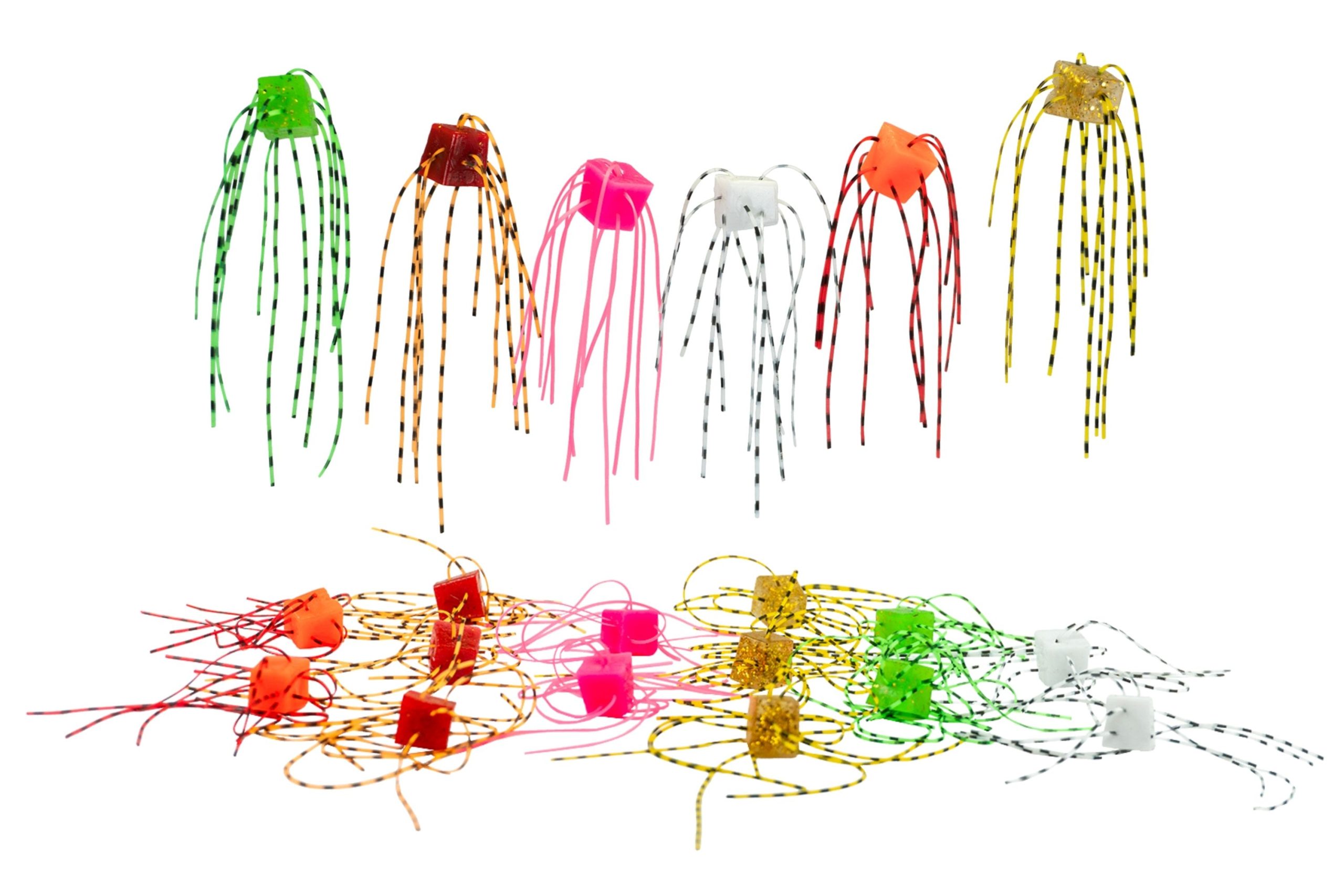
Dice baits (often called “fuzzy dice” baits) are one of the newest soft-plastic categories to gain serious traction because they do something standard plastics struggle with: they create micro-movement and an odd silhouette that fish haven’t been conditioned to ignore.
Instead of relying on a tail kick or exaggerated action, dice baits win by hovering, quivering, and looking “alive” even when you barely move them. That makes them especially effective when fish are pressured, soft-biting, or simply tired of seeing the same shapes.
A dice bait is a small, compact soft plastic—often cube-shaped—designed to be fished slowly with finesse presentations. Many versions include fine filament threads or skirt-like strands that extend outward and move with minimal rod tip input.
The category stands out because it doesn’t look like a traditional baitfish, worm, or craw. That unfamiliar look is part of the trigger: when fish have seen every normal profile, something “different” can generate curiosity and reaction bites.
Dice baits are built to win in tough conditions where standard finesse plastics start to feel “invisible.”
They tend to produce because of three things:
If you’ve ever watched fish follow a bait and stop short, dice baits are a strong “change-up” because they stay interesting without moving far.
These baits are at their best when you rig them to hover, pendulum, or crawl slowly. Think finesse tools—not power fishing.
The drop shot is one of the most reliable ways to fish a dice bait because it keeps the lure suspended where fish can study it.
How to fish it:
Best for: pressured bass, clear to lightly stained water, suspended fish, edges of cover
A small jighead gives you bottom contact while still keeping the presentation subtle.
How to fish it:
Best for: rock/wood structure, points, edges, tougher bites
Hooking through an edge or corner of the bait can create a unique “hover and shimmy” that complements the threads.
How to fish it:
Best for: docks, shade lines, pressured fish that won’t chase
A weightless approach can be deadly when fish want something that barely moves.
How to fish it:
Best for: shallow cover, calm conditions, fish that are curious but cautious
Dice baits are a finesse tool, but they’re not limited to one scenario. They tend to excel in:
They’re also a strong choice when you’re getting follows, short strikes, or bites that don’t hook up on faster-moving baits.
The most common mistake is working them too aggressively.
A simple cadence that works in most situations:
If you’re fishing a drop shot, make the bait look alive without moving it far.
Dice baits are best when fish are pressured or selective, but they can work across multiple species that respond to subtle movement and unusual profiles.
They can be effective for:
Email: Sales@delonglures.com
Phone: 234 -788-9308
Address: 2381 Locust St
Canal Fulton, Ohio 44614